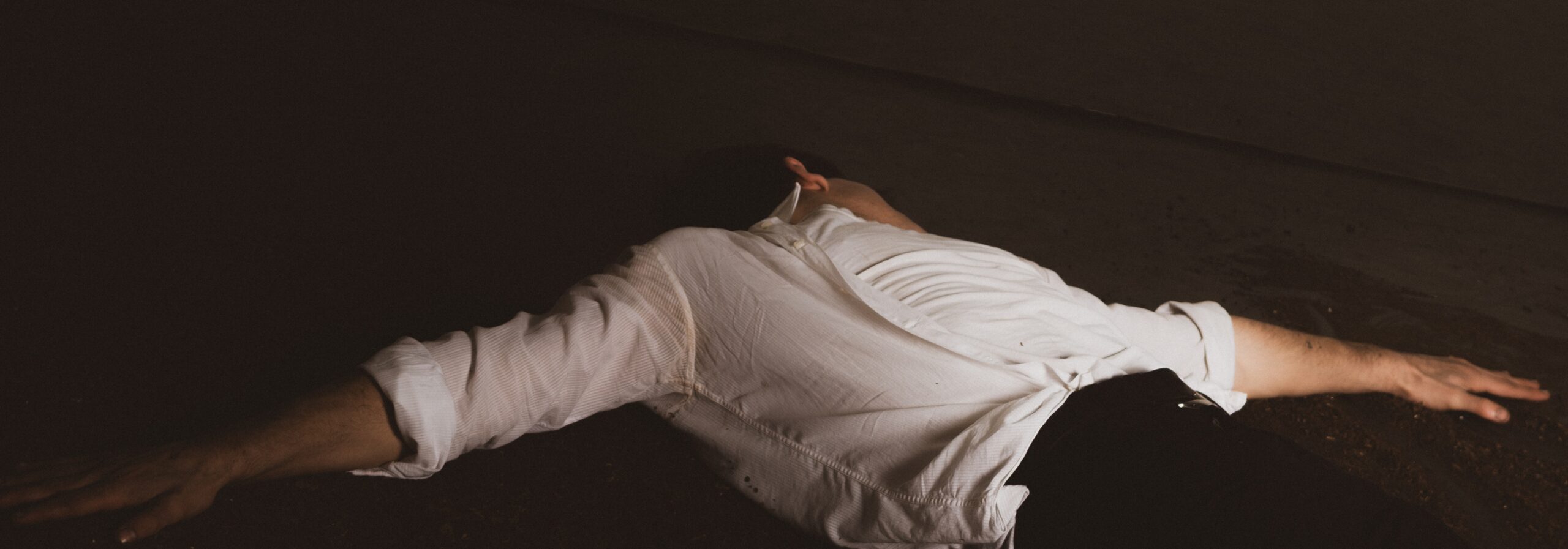
Carusə moves through the silenced dance of tarantism as a practice of transformation. The performance investigates the symbols and generative processes of possession dance, exploring the forms of haunting that re-emerge within the contemporary hauntological regime, opening a space of listening and negotiation capable of giving voice to the invisible and making a more cohesive present possible. At its centre is a young, male body: youth as porosity and the capacity to enter into relation with historical and affective memories, masculinity as the dislocation of a traditionally feminine phenomenon. Through practices of endorcism, trance and suspension, the body exposes itself as a vulnerable and generative site. The musical dramaturgy, built on the friction between ancient lyrical arias and the contemporary body, opens a space of resistance and affectivity, interrogating patriarchy, gender and queer subjectivity.
Although intended for a general audience, the performance favours non-normative spaces, where close-range proxemics amplify tension and make the fragility of bodies visible. The scenic device enacts trauma and transformation, pushing physical limits, disrupting perception and destabilising gesture: the body becomes an active agent of experimentation — vulnerable, unstable, capable of generating collective resonance. In this context, Carusə looks to an epistemic youth (giovinezza epistemica): an age of openness, porous to what traverses it.
Carusə | sine Sole sileo
is a choreographic and performative work freely inspired by tarantism and by The Land of Remorse by Ernesto De Martino (1961). It brings into the present a past in which collective wounds and desires took shape in ritual dances, investigating how those same urgencies resonate today.
The research focuses on endorcism — a practice that integrates and transforms the hidden forces of the body and the social — to explore the forms of a possible contemporary tarantism. Through dance, Carusə restores to the body the capacity to transform melancholy and desire into vital energy, overcoming alienation and opening onto a dimension of regeneration and freedom.
Carusə | sine Sole sileo is a performance of approximately 25 minutes — a work in progress — that reinterprets the silenced dance of tarantism in light of its contemporary resonances. It is not about recovering a rite from the past, but about investigating how its tensions — mutated, distorted, sublimated — act on the body today, urging it to produce forms of transformation that are no longer reduced to silence.
The work proposes a masculine rereading of tarantism, traditionally associated with the female body, opening a queer perspective that recognises in crisis a space of mobile identities and exceeding desires.
The performance takes youth as an epistemic condition: an age of openness to hauntology, in which the body is a threshold, porous to the presences of the no-longer and the not-yet, capable of welcoming what traverses it without neutralising it. Can a very young, male and queer body become a vehicle for contemporary melancholy and ennui, and restore this through physicalities born of a silenced dance — while simultaneously creating new postures that speak of a present in rebirth, against the alienation and suppression of bodies today?
Within this youthful and spectral sensibility, tarantism reveals itself as a possible poetic technology of the present: a means through which the body transforms the bite into vital energy, converting vulnerability and desire into movement.
It is in this juncture that the idea of endorcism emerges: a practice that does not expel what hurts, but integrates it, metabolises it, transfigures it into generative power. Carusə thus constructs a performative device that imagines the body as an organism adaptable to the times — capable of transforming memory, traumas, and desires into new and freer forms of existence.
Choreographic and Dramaturgical Notes
Movement develops from research tasks inspired and evoked by the themes of exorcism and endorcism. The choreography, strongly physical, progressively translates into a ritual sign language, at times taking on the quality of genuine prayer.
The physical qualities explored and most sought after are repetition, trance, tension, and vibration (shaking): elements that not only represent but above all evoke the process of transformation and metamorphosis required by the tarantism phenomenon, up to a possible catharsis. Within this research, the use of symbolic body parts — eyes, neck, feet — subjected to unusual efforts or forms, as well as specific movement qualities, plays a significant role in rendering the introjection of external energy (of symbolic animal origin) in the process of invoking endorcism.
The scenic space is conceived as a tripartite journey:
- a circle of wheat that welcomes the body of the Carusə at its beginning;
- a central spiral of earth, the place where the act of exorcism/endorcism is consummated;
- a cross of white embroidered cushions, in which a renewed body rests, sealing the transformation.
The musical dramaturgy also unfolds on multiple levels:
- a first track created by the director — a soundscape of recorded noises and voices capable of evoking a landscape both ancient and ghostly, yet brutally contemporary;
- two tracks by contemporary composers: the first with a ritualistic character, the second closer to a festive dimension, resembling a party, reflecting the current nature of the energies that sustain the piece;
- in the opening, as an overture, the performer sings a song by Connie Converse, drawing the audience into an intimate and suspended dimension.
Project Status
Carusə | sine Sole sileo is a work in progress, currently in a phase of research and ongoing choreographic experimentation — though available for open-audience showings in the format of a first study. Several rehearsal sessions have already been conducted to explore tasks related to exorcism, endorcism, and the introjection of social energies (haunting) in the body, as well as the dramaturgy of the scenic space and musical sequences.
- Expected running time: 45 minutes
- Number of performers: 1
- Expected premiere: within 2026
- Residencies or workshops held: initial study sessions conducted in Lecce at Koreoproject’s Barrakk’Art space; future residency opportunities are being sought to consolidate the dramaturgy and physical development.
- Immediate goals: consolidate the ritual sequences, refine the physical and gestural quality of the movement, define the musical score and the use of the tripartite scenic space, develop a lighting dramaturgy with the support of theatrical technicians.
PH Elisa Caputo

