A new out-of-season event enriches UMANO COLLETTIVO, the 2026/27 theatre season of the Municipality of Bari in collaboration with Puglia Culture. On the eight hundredth anniversary of the Saint’s death, the work, based on the book by Enzo Quarto and directed by Francesco Carrassi, retraces his human story through live theatre, music and dance. The performance is accessible in Italian Sign Language (LIS).

Renouncing power to restore the human being to the center. It is perhaps in this paradox, so far removed from the logic that runs through our time, that one of the deepest and most relevant legacies of Francis of Assisi lies. His choice of poverty, his rejection of violence and his closeness to the least among us do not belong only to the history of spirituality, but continue to question the relationship between individual conscience, collective responsibility and human dignity.

This deeply human dimension is the subject of Tutta la vita per lasciare ogni potere. Giovanni detto Francesco, il Santo più amato (A Lifetime to Give Up All Power. John, Called Francis, the Most Beloved Saint), which premieres on Saturday 31 October 2026 at 8:00 PM at Teatro Piccinni in Bari, adding a new out-of-season event to UMANO COLLETTIVO – the 2026/27 theatre season of the Municipality of Bari, produced in collaboration with Puglia Culture – Circuito Teatrale.

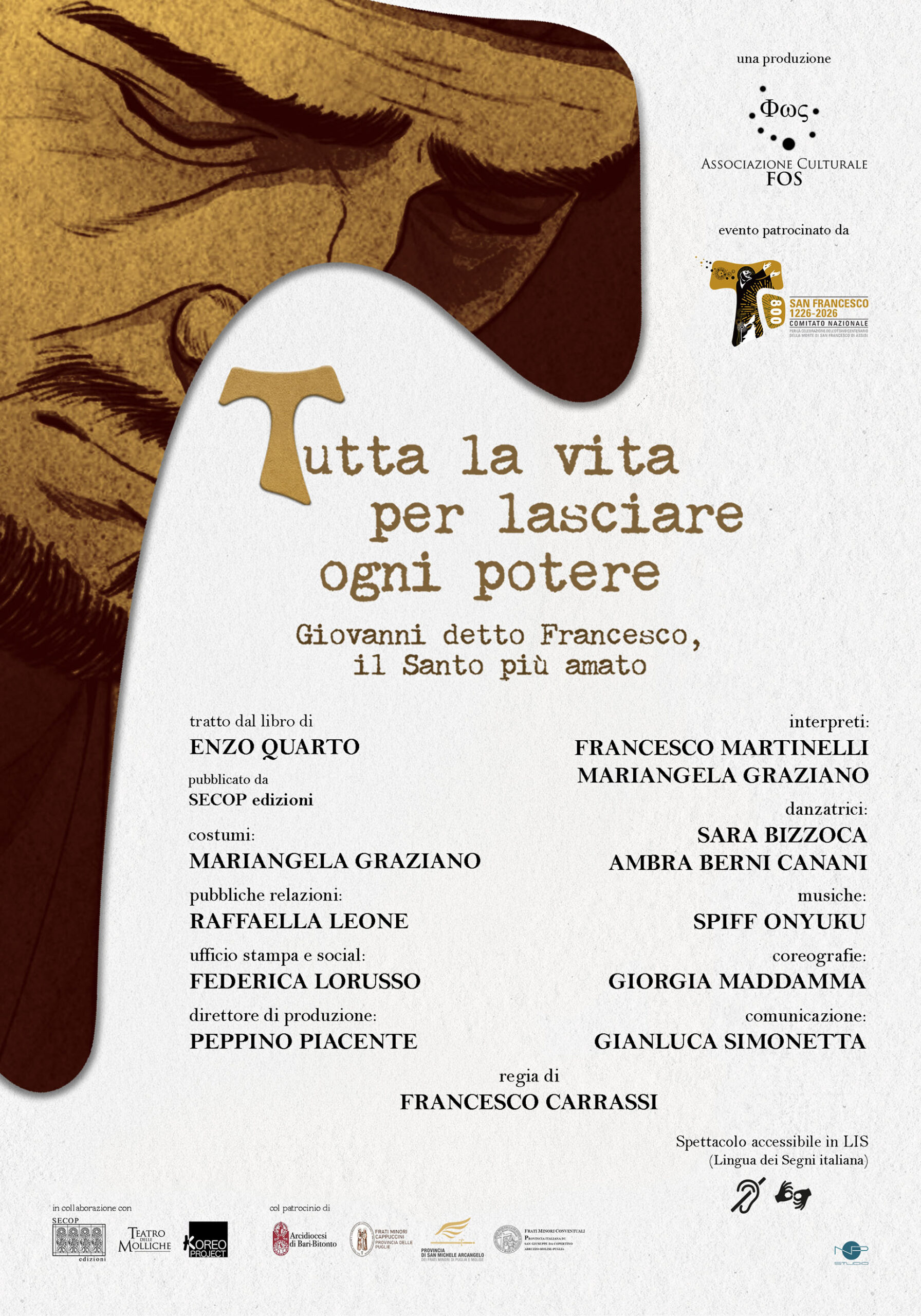
Based on the book of the same name by Enzo Quarto, published by SECOP edizioni in 2026 with illustrations by Nicole Ciannamea, the show is directed by Francesco Carrassi and produced by the Associazione Culturale FOS of Corato, in collaboration with SECOP edizioni, Teatro delle Molliche and Koreoproject. Promotion and distribution are handled by Puglia Culture.

The performance takes on special meaning in the year of the eight hundredth anniversary of the death of Saint Francis, offering an opportunity to return to a figure who has crossed eight centuries of history without exhausting the power of his questions.
“Tutta la vita per lasciare ogni potere is a show that speaks to our time through the strength of essential things. I thank the cultural association FOS for bringing this project to the stage, based on the book by Enzo Quarto, directed by Francesco Carrassi, with illustrations by Nicole Ciannamea,” said Paola Romano, Councillor for Culture of the Municipality of Bari. “Saint Francis is the most beloved saint because he chose to strip himself of all wealth and privilege, renouncing power to place the dignity of every person at the center. Telling his life through the female figures who accompanied his journey, from his mother to Clare, from Jacopa to Sister Death, means rediscovering the value of care, friendship and freedom as the foundations of human relationships. I am also struck by the way this work weaves together different languages, from words to live music, from dance to movement, thanks to the contribution of Francesco Martinelli, Mariangela Graziano, Spiff Onyuku, Giorgia Maddamma, Ambra Berni Canani and Sara Bizzoca. These are artists rooted in our territory, with nationally and internationally significant careers, who testify to the vitality and quality of Apulian cultural production. Francis’s message is precious also for those who govern a city: power finds its highest meaning when it translates into service, listening and attention to others. It is a reflection we feel particularly close to and which, through theatre, can reach diverse audiences. I invite all citizens not to miss this show.”

“On the eight hundredth anniversary of the death of Francis of Assisi, returning to his story through theatre means connecting the understanding of a historical experience with the questions of the present. Artistic research can contribute to this reflection by exploring the relationship between the exercise of power, individual responsibility and community life. It is not a matter of attributing to the past answers that can be immediately applied to the contemporary world, but of recognizing its capacity to prompt a critical dialogue, respecting the differences between historical contexts,” said Paolo Ponzio, president of Puglia Culture. “The inclusion of Tutta la vita per lasciare ogni potere in the UMANO COLLETTIVO season of the Municipality of Bari, produced in collaboration with Puglia Culture, fits into this perspective. Alongside the presentation of shows, the theatre programming aims to offer opportunities for learning, discussion and participation, connecting stage research with the issues of civic life. The task of cultural institutions also consists in fostering this encounter, creating the conditions for artistic experience to nourish shared reflection. Translation into Italian Sign Language (LIS) is a concrete choice in this direction. Accessibility is an essential dimension of cultural planning and a condition for the effective exercise of the right to participation. Reducing linguistic and communication barriers means recognizing the plurality of audiences and translating the principle of inclusion into concrete ways of experiencing theatre. The public function of culture is thus also expressed in the responsibility to identify and overcome the obstacles that limit access to it. This is the idea of theatre we intend to support: a space for interpreting historical memory and discussing the issues of the present, in which cultural participation can contribute to the formation of critical awareness and the exercise of citizenship.”

FRANCIS, THE MAN BEFORE THE SAINT

Not a hagiographic reconstruction, but a journey through Francis’s human experience, the relationships that accompanied his path and the choices that transformed his life.

The dramaturgy unfolds through a dynamic monologue in which words, movement and music work together to convey the essential passages of a story marked by the progressive renunciation of possession and authority.

The deliberately essential set entrusts light, the presence of the performers and a few symbolic gestures with the task of evoking places, encounters and inner transformations. At the center is not only the figure of the Saint, but that of a man who, escaping the conventions of his time, finds in freedom from power a different possibility of relating to others and to the world.

Alongside the protagonist and his inner voice, dance introduces a symbolic dimension to the story through four fundamental female figures: the Mother, origin and freedom; Clare, choice and poverty; Jacopa, friendship and care; and finally Sister Death, the fulfillment of a life.

These are presences that do not simply accompany the narrative, but convey its relational character, bringing out a Francis whose spiritual experience also takes shape through affections, encounters and the recognition of the other.

THEATRE, DANCE AND LIVE MUSIC

The performers are Francesco Martinelli, in the role of Saint Francis, and Mariangela Graziano, who gives voice to the protagonist’s inner dimension and also designed the costumes.

The choreography is by Giorgia Maddamma, with dancers Sara Bizzoca and Ambra Berni Canani, while the music is by Spiff Onyuku.

The sound score does not serve a purely illustrative function, but takes part in the dramaturgical construction: from indistinct sound to breath, from breathlessness to music, it accompanies the gradual unveiling of the protagonist’s human experience.

The result is a stage writing in which different languages converge in a single expressive search, entrusting words, body and sound with the task of conveying the complexity of a figure who continues to speak to the present.

A STORY SPANNING EIGHT CENTURIES

Francis’s story thus becomes an opportunity to question issues that also belong to the present day: the relationship between wealth and poverty, the exercise of power, war, social exclusion, and every person’s right to have their dignity recognized.

His rejection of oppression and his choice of a life founded on fraternity bring to the stage a reflection that goes beyond the strictly religious dimension, addressing a broader civic and cultural sensibility.

In the year of the Franciscan celebrations, the show chooses to look at the past without separating it from the present, recognizing in the Saint’s story a chance for critical questioning of our time.

The production is also accessible in LIS – Italian Sign Language, confirming its attention to participation and accessibility in live performance.

The production enjoys the patronage of the National Committee for the celebration of the eight hundredth anniversary of the death of Saint Francis of Assisi, the Archdiocese of Bari-Bitonto, the Capuchin Friars Minor, the Friars Minor of Puglia and Molise, the Conventual Friars Minor and A.N.I.LIS – the National Association of LIS Interpreters.

INFORMATION AND TICKETS

“Tutta la vita per lasciare ogni potere. Giovanni detto Francesco, il Santo più amato”
Saturday 31 October 2026 – 8:00 PM, Teatro Piccinni – Bari
Out-of-season show. Accessible in LIS – Italian Sign Language

Tickets are available online on Vivaticket, at the circuit’s sales points and at the Teatro Piccinni box office, open Tuesday to Saturday from 10:00 AM to 1:00 PM and from 5:00 PM to 8:00 PM.

www.pugliaculture.it
https://www.pugliaculture.it/evento/tutta-la-vita-per-lasciare-ogni-potere/